Where Should CCTV Cameras Be Positioned?
Published
· Volt East Group
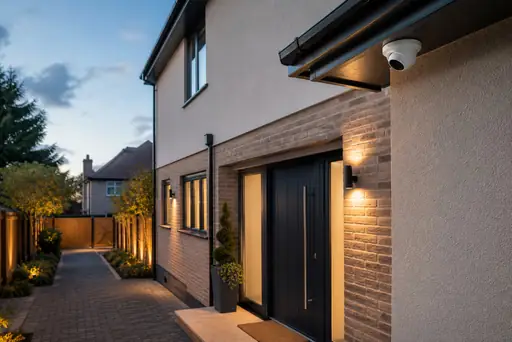
The best place for a CCTV camera is not simply the highest corner of a building. A useful system starts with a clear purpose: what needs protecting, which movement or event must be seen, and what detail would be needed if an incident occurred?
That matters because a camera can show a wide area yet still fail to capture a usable face, vehicle or sequence of events. Poor lighting, obstructions, an unsuitable viewing angle or an excessive field of view can all reduce the value of the recording. A camera can also create unnecessary privacy issues if it captures neighbouring property or public space without good reason.
This guide explains how homeowners, landlords and businesses can plan CCTV camera positions before asking for quotations or approving an installation.
Start with the outcome, not the number of cameras
Before choosing equipment, write down what the system is expected to do. Typical objectives might include:
seeing who approaches and enters the property;
observing a side passage, rear access point or delivery area;
covering a driveway, car park or vehicle entrance;
recording movement around a stockroom, plant room or other controlled area; or
allowing an authorised person to check the property remotely.
Each objective calls for a different view. A broad overview can help establish the route somebody took, while a tighter view may be needed to obtain useful identifying detail. Trying to make one camera perform both jobs across a large area can leave you with footage that looks impressive on a phone but reveals very little when enlarged.
A simple site plan is often the best starting point. Mark the doors, gates, paths, parking areas and any places hidden from normal view. Then decide which areas are genuinely important rather than assuming every part of the boundary must be recorded.
Prioritise the routes people actually use
Entrances and approach routes usually deserve attention because they show how somebody arrived, where they went and how they left. Depending on the property, relevant locations may include the front door, a side gate, a rear entrance, a driveway or a commercial loading point.
The aim is not just to point a camera at a door. Consider where a person is likely to pause, which direction they will face, and whether the camera can see them before a hood, vehicle, open door or porch roof blocks the view. At a business, think about normal customer and delivery movement as well as out-of-hours access.
Avoid creating blind spots where two views stop just short of one another. However, more coverage is not automatically better. The Information Commissioner’s Office advises domestic users to position cameras so they only capture their own property where possible. For organisations, it similarly says the system should capture what is needed and nothing more.
Choose between an overview and identifying detail
Camera position should follow the information the image needs to provide.
An overview camera can show activity across a driveway or yard, but people may occupy only a small part of the picture. A camera intended to help identify somebody should produce a clear, appropriately framed view at the point they are likely to pass. West Yorkshire Police notes that recorded images need to be sufficiently clear for someone to be identified and that both resolution and low-light performance affect image quality.
This is why camera height and angle should be tested rather than selected from a generic rule. Mounting a camera very high may make it harder to see a face beneath a hat or hood. Mounting it too low can make it easier to interfere with. The right compromise depends on the route, the lens, the available light, the risk of tampering and the detail required.
Ask to see a sample image from the proposed viewpoint before the position is finalised. Check both the full scene and the level of detail available on a person moving through the important area.
Test lighting in the real conditions
A clear daytime image does not guarantee useful footage at night. Streetlights, vehicle headlights, illuminated signs, bright doorways and infrared reflection can all change what a camera records.
Backlighting is a common problem. If a camera faces a bright entrance from a darker interior, a visitor’s face may appear as a silhouette. Infrared light can also reflect from nearby walls, soffits, windows, cobwebs or foliage and overwhelm part of the image. Trees and plants may block the view as they grow or repeatedly trigger motion alerts when they move.
Review proposed camera views after dark as well as during the day. Check whether existing lighting is consistent, whether new lighting would help, and whether it could cause glare or nuisance to neighbours. ProtectUK advises that carefully designed external lighting can improve CCTV performance while warning that the effect of light pollution should also be considered.
Think about privacy before fixing the angle
CCTV planning is also privacy planning. The easiest time to minimise unnecessary recording is before the camera is fixed in place.
For a home system, the ICO says owners should position cameras to capture only their own property where possible. If a camera records beyond the boundary—for example, a neighbour’s property, a communal space or part of the street—data-protection law applies. The owner should have a clear reason, avoid capturing more than is needed, let people know CCTV is in use, keep footage secure, delete it regularly and be able to respond appropriately to requests from people recorded.
Sometimes a small area beyond the boundary cannot be avoided. Adjusting the angle or using privacy masking may reduce intrusion while preserving the security objective. Audio requires particular caution because recording conversations can be significantly more intrusive than recording images.
Businesses and other organisations have wider responsibilities. The ICO advises them to document why CCTV is needed, which areas it will cover, how privacy impacts will be reduced, who can access recordings and how long footage will be kept. Signs should explain that CCTV is operating, why it is being used and who can answer questions. Areas where people reasonably expect privacy, such as toilets and changing rooms, should not normally be recorded.
The ICO notes that its CCTV guidance is currently under review following changes to data-protection legislation, so owners and organisations should check the latest official position when planning a system.
Plan recording, access and storage with the camera views
Positioning and recording settings should be considered together. A useful design brief should establish:
whether cameras record continuously, on a schedule or when activity is detected;
how long recordings need to be retained for the stated purpose;
whether storage is local, cloud-based or a combination;
who is authorised to view, download or share footage;
whether remote viewing is needed and how accounts will be secured;
what happens if the internet, local network or power supply is interrupted; and
how incidents will be found and exported without retaining unrelated footage indefinitely.
Strong passwords, limited user access, current software and multi-factor authentication where available all reduce the risk of somebody gaining unauthorised access. The system should also have enough storage for the selected image quality, camera count and recording pattern. Retention should follow a justified operational need rather than an arbitrary “keep everything” setting.
For a business, the person responsible for CCTV should know how to retrieve relevant footage and handle requests involving personal data. The ICO also advises organisations to set and document a retention period, delete footage that is no longer needed and protect recordings against unauthorised access.
Homes and businesses need different plans
At a home, the priority is often a small number of external approaches. The system should support the household’s security without unnecessarily recording neighbours or shared areas. Remote alerts may be useful, but poorly defined motion zones can create so many notifications that important events are missed.
A business may have several user groups, access levels and operational risks. The design might need to distinguish customer entrances, staff-only areas, deliveries, vehicle movements and out-of-hours access. It must also consider staff and visitor privacy, signage, access to footage, retention and responsibility for day-to-day operation.
For blocks of flats or managed developments, communal areas require especially careful treatment. Clarify who controls the system, what authority they have, which areas are included, who will respond to requests and how residents will be informed. A camera installed by one resident is not the same as a system operated by a landlord, freeholder or managing agent.
Common CCTV positioning mistakes
Several avoidable mistakes can undermine an otherwise capable system:
choosing camera positions before defining the security objective;
covering a very wide scene when useful identifying detail is needed;
mounting every camera at the same height regardless of the route and risk;
testing only in daylight;
placing infrared cameras too close to reflective surfaces or foliage;
allowing doors, vehicles, gates or seasonal growth to block important views;
capturing neighbouring property or public space without considering whether it is necessary;
enabling audio simply because the camera supports it;
relying on remote viewing without planning secure accounts and local resilience; and
failing to agree who will maintain the system, review alerts and handle footage.
A good installation should be tested as a complete system, not just as a collection of online camera feeds.
A pre-quotation CCTV checklist
Before requesting an installation quotation, prepare the following information:
The main reason for installing CCTV.
The entrances, routes, assets or events that need to be seen.
Whether each view needs an overview, identifying detail or both.
The daytime and night-time lighting conditions.
Areas that must be excluded or privacy-masked.
Whether audio is proposed and why it is necessary.
Preferred recording, retention and storage arrangements.
Who needs live or recorded access.
Available power, network coverage and cable routes.
Who will maintain the system and respond to faults or alerts.
This gives installers a defined brief and makes quotations easier to compare. It also creates a better basis for deciding whether a camera has been placed successfully: the final view can be tested against the agreed purpose.
Planning CCTV installation in Romford, Essex or London?
Volt East provides CCTV installation for homes, landlords and businesses across Romford, Essex and London. The installation can be planned around the areas you need to monitor, the image detail required and how you want to access recordings.
If CCTV will form part of a wider connected-property setup, see Volt East’s home automation systems service. When you enquire, include a simple property plan, the priority entrances or routes and any privacy or remote-access requirements already identified.
External sources used
Plan your next project with Volt East
Use our practical guides to prepare the brief, then speak to Volt East about electrical installation, lighting design, security or smart-home work across Romford, Essex and London.