LED Lighting Design Mistakes That Make Expensive Projects Feel Flat
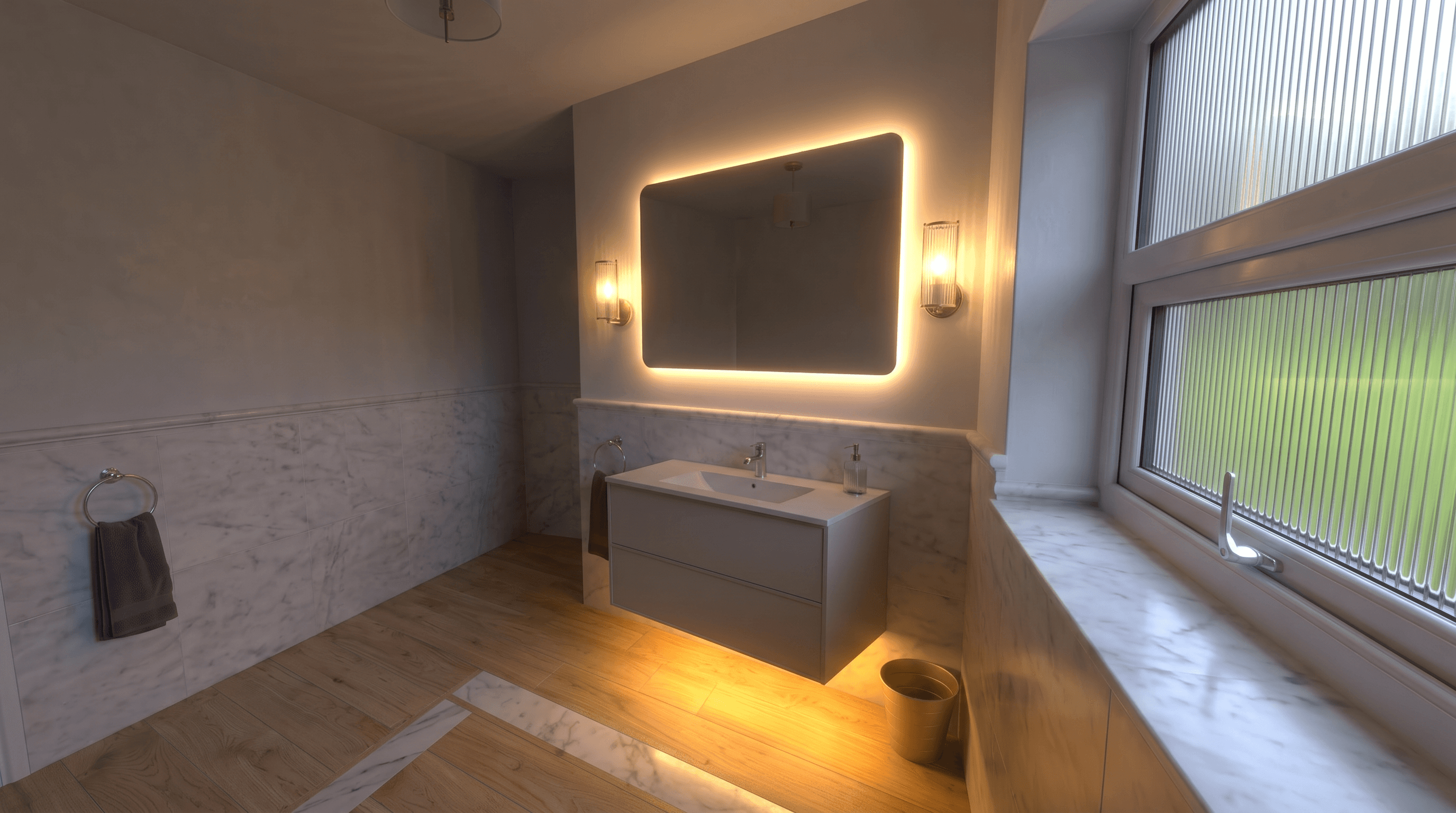
Table of Contents
No anchors found on page.
LED lighting is usually the right direction for modern projects.
It is efficient, flexible, long-lasting and much better suited to layered lighting than older fitting types. But that does not automatically mean the end result will feel good.
In fact, some of the flattest, harshest and least satisfying spaces are fitted entirely with LED lighting.
That sounds backwards, but it happens all the time.
Because the problem is rarely the technology itself. The problem is usually the way the lighting has been planned.
The short answer
LED lighting works best when it is treated as part of a full lighting design, not just as a product choice.
If the layout is rushed, the colour temperature is wrong, the layers are missing, or the room has been lit too evenly, even an expensive scheme can end up feeling cold, flat or awkward to use.
That is where design matters.
It helps shape how the space should feel before the fittings are chosen, which is often the difference between a room that feels polished and one that never quite lands.
Mistake 1: Thinking LED lighting solves the design on its own
This is probably the biggest one.
People often assume that because LED lighting is the modern option, using it automatically leads to a better result. It does not.
LED is the tool, not the design.
A project can still feel overlit, under-layered or visually flat even if every fitting is high quality. If the room has no real hierarchy to the light, no softer zones, and no balance between practical lighting and atmosphere, the technology itself cannot rescue that.
This is why lighting design has to come before the final specification. The room needs a plan, not just efficient products.
Mistake 2: Using too many downlights and calling it done
This one shows up everywhere.
A ceiling gets filled with downlights because they feel simple, clean and safe. On paper, it looks like the room is covered. In reality, the result is often very one-note. The room is bright, but it is not interesting. Everything sits at the same level, and there is very little sense of atmosphere or depth.
That is where a project starts to feel expensive in finishes but strangely flat in mood.
A better LED lighting scheme usually relies on more than one layer. That might include ceiling lighting, feature lighting, pendant lights, joinery lighting, wall lights or lower-level ambient light depending on the room. The point is not to add fittings for the sake of it. It is to stop the whole room being forced into one uniform lighting condition.
Mistake 3: Getting the colour temperature wrong
This is one of the easiest ways to throw the feel of a room off.
If the colour temperature is too cool, the space can feel clinical or hard, even when the finishes are warm and expensive. If it is too warm in the wrong setting, the room can feel muddy or underpowered. And when different fittings across the same space do not match properly, the whole scheme can start to feel disjointed without people always knowing why.
This matters even more in open-plan homes, kitchens and design-led commercial interiors, where one area flows directly into another. LED lighting gives you a lot of flexibility here, but that only helps if the tone of light has been considered properly from the start.
Mistake 4: Lighting everything equally
This is where expensive projects often lose their sense of depth.
If every wall, surface and zone is lit to a similar level, the room can feel visually flat. There is no emphasis, no hierarchy and nothing for the eye to settle on. The result is not necessarily dark or badly lit. It is just dull.
Good lighting design usually relies on contrast. Some parts of the room need to do more. Some need to stay softer. Some deserve focus. Some are better left quieter.
That is what creates shape and atmosphere.
Without that, the room can end up feeling like it has been illuminated rather than designed.
Mistake 5: Forgetting what the room is actually used for
This sounds obvious, but it gets missed surprisingly often.
A room can look great in a moodboard and still be frustrating to use in real life if the lighting does not support what actually happens there. Kitchens need task light in the right places. Dining areas need presence without glare. Living rooms need softer evening light. Bedrooms usually need calm, layered control rather than one bright source overhead.
This is where LED lighting is at its best when it is planned well. It can adapt to all of those different needs. But if the layout is driven only by symmetry or by what looks neat on a reflected ceiling plan, the room can quickly lose that practicality.

Mistake 6: Choosing fittings before deciding how the space should feel
This is one of the most common project habits.
People start falling in love with fittings before they have answered the bigger question: what is the atmosphere supposed to be?
That order matters.
A pendant, downlight or track fitting might be a good choice, but only once the room’s mood, use and visual priorities are clear. If not, the project can easily end up being shaped by individual products rather than by the actual experience of the space.
That is one reason Volt East’s Lighting Design offering is so useful. It helps clients explore the feel of the project before they commit to the final scheme.
Mistake 7: Not planning for evening use
A lot of lighting layouts are judged too heavily on how they look in the daytime or during a quick site walkthrough.
But most people actually experience their homes and hospitality-style spaces in the evening, when artificial light is doing most of the work.
That is where poor LED lighting design becomes much easier to notice.
Rooms that seemed fine on paper can suddenly feel too bright, too stark or too uniform at night. The kitchen dominates the whole open-plan space. The lounge has no softer scene. The dining area feels disconnected. The whole room feels more functional than comfortable.
This is why design should always think beyond simple brightness. The room needs to work once daylight disappears.
Mistake 8: Ignoring controls and dimming
Even a strong lighting layout can feel limited if the control side has been ignored.
A room used for cooking, dining, working and relaxing should not be stuck at one lighting level all day. That is exactly where smart lighting and better control make a real difference. Dimming, grouped zones and simple scenes can turn a technically good lighting scheme into one that feels genuinely easy to live with.
Without that flexibility, the room may still look good, but it will not always behave well.
That is especially true in open-plan homes, hospitality environments and spaces where the mood needs to shift through the day.
Mistake 9: Treating feature lighting as an extra
Feature lighting is often one of the first things to get cut or simplified when a project starts being value-engineered.
Sometimes that is the right call. Sometimes it is exactly what makes the room lose its identity.
That does not mean every scheme needs dramatic feature lighting. But it does mean the right accents can be what stop an expensive project from feeling generic. Joinery lighting, shelf lighting, a better pendant arrangement, subtle wall emphasis or architectural highlights can all make a room feel more deliberate.
Without those moments, even high-end spaces can end up relying too heavily on functional light alone.
Mistake 10: Waiting too late to think about the lighting properly
When the lighting conversation happens too late, the whole project becomes reactive. The kitchen is already chosen. The ceiling details are already set. The joinery is already fixed. The furniture layout is mostly decided. Then someone tries to work out the lighting around what is left.
That is usually when compromises start.
A better approach is to plan the lighting while the rest of the design is still flexible enough to respond. That gives far more freedom to create balance, atmosphere and proper control before expensive decisions are locked in.
Why these mistakes are so noticeable in higher-spec projects
The bigger the investment, the easier it is to see when the lighting has not kept up.
That is because premium materials, bespoke joinery, feature kitchens and carefully designed interiors all need the lighting to support them properly. If the room has been finished to a high standard but the lighting is flat, over-bright or poorly controlled, the whole project can feel less resolved than it should.
That is why LED lighting design matters so much in more ambitious projects. It protects the quality of the investment rather than just ticking the box for illumination.
Where Volt East fits in
This is exactly the sort of conversation Volt East’s Lighting Design page is there to support.
If a client is planning a renovation, open-plan remodel, commercial interior, landscape scheme or higher-spec room upgrade, design input helps them avoid the common mistakes before the money is fully committed.
That can help shape:
LED lighting layout
colour temperature choices
pendant and feature lighting placement
zoning and layering
smart lighting controls
how the room or building will actually feel once complete
That is often the difference between a space that simply has new lighting and one that genuinely feels better because of it.
Final thoughts
LED lighting is a brilliant tool, but it is still only a tool.
It can make projects more efficient, more flexible and more refined, but only when the design behind it is strong enough to support the result. If the layout is rushed, the lighting is too even, the colour temperature is off or the room has no proper layering, the project can still end up feeling flat no matter how much has been spent.
For Volt East, this is a strong topic to support the Lighting Design page because it makes the value of early design input very clear. The goal is not just to choose better fittings. It is to avoid the kind of decisions that leave expensive projects looking less resolved than they should.